


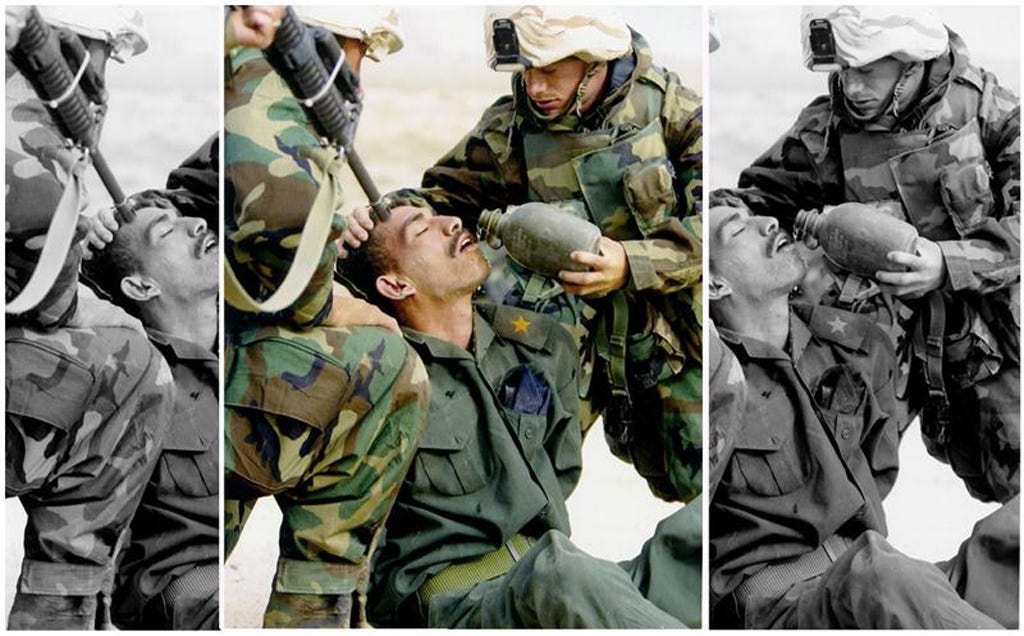
You can mislead people without lying. At scale, that’s what makes media dangerous.
Based on my experience in Psychological Operations, I want to share a few things you should look out for. I want to highlight the tactics Fox and CNN use to keep you watching, but that fail to serve you.
Then we’ll talk about how you can design your own narratives. How you can share your story in a way that truly serves both you and your audience.
The first thing you should look out for is information asymmetry. That’s why you check the news, after all. You want to know what’s going on and the media is the gatekeeper. But as we all know, first impressions carry weight. And that makes Headlines particularly problematic.
Headlines (and captions) are first impression that capture and direct your attention. Their brevity excuses omission. And omission distorts reality.
Every decision on what to include and what to leave out gives an impression. Sometimes false impressions. Even if what you say is technically true. And that distortion is the space where exploitation lives.
Let’s look at this CNN example: “What it will take to save American Democracy”
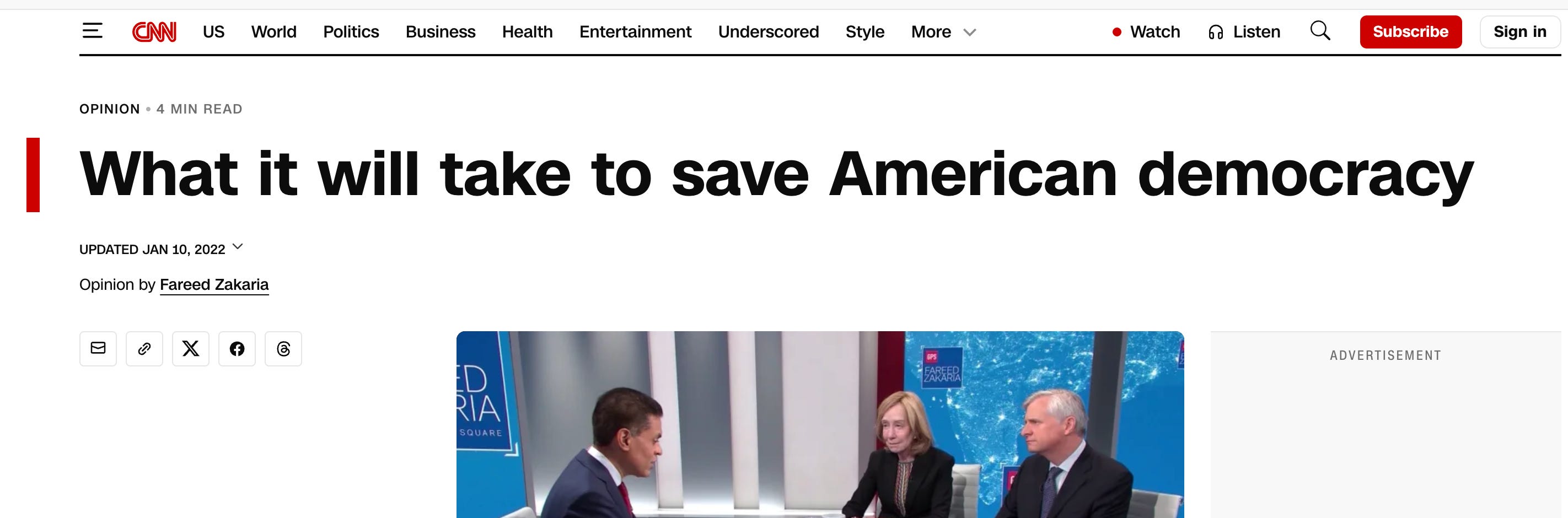
Notice how Fareed built in the assumption that American democracy is in shambles. It never gives you the space to consider the matter. The notion has already taken root before you’ve had a chance to process anything.
These authoritative headlines often use curiosity gaps to get you to click; these are statements engineered to say something emotionally charged but leave enough unsaid so you’re compelled to look into it.
The catch is, our brain gets blinded with emotion and is so caught up in the curiosity gap, the assumptions behind the gap bypasses our critical thinking. And that comes in handy when establishing a narrative.
When you plant the seed of an idea, and repeat it often enough, it becomes truth. At first, the effect is weak. But, eventually the distinction between narrative and truth fades with every repeat exposure to the idea.
Now let’s layer that effect with a potent force multiplier: Information overload.
Algorithmic feeds and the 24-hour news cycle are plagued by a demand for content. That demand excuses noise. The overwhelming kind that distracts you from what matters. When everything is bolded, nothing is.
In Psychological Operations we’d refer to this as the information environment. We live in the noisiest one our species has ever known. One beyond what our species can manage.
Look at how Fox takes advantage of this dynamic:

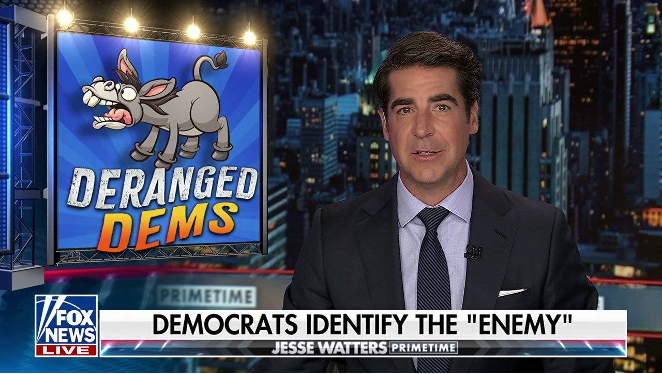

Fox works their magic by labeling. They’ve coined the terms “Dems” and “Libs” and have repeated them until it’s become a meme.
When you’re overwhelmed by vicious amounts of information and entertainment, who has the bandwidth to really look into any of it? So we take most of it in.
Fox uses those labels to create tribes that instigate a compelling “us” vs “them” dichotomy.
Then they go one step further, naming and shaming them as “fanatics” or “deranged.” They reduce them to a group that is too dumb to be reasoned with.
Before I worked in Psychological Operations, I was in the infantry. When I see Fox News, their tactics remind me of the book “On Killing.” Dave Grossman’s book is one of the few available when I trained to be an infantryman.
Grossman discusses how propaganda reduces resistance to killing by depicting opponents as subhuman. He notes that “often the enemy’s humanity is denied by referring to him as a ‘gook,’ ‘Kraut,’ or ‘Nip.’”
Grossman goes further, saying you must “believe that not only is this atrocity right, but it is proof that [you are] morally, socially, and culturally superior to those whom [you have] killed. It is the ultimate act of denial of their humanity. It is the ultimate act of affirmation of [your] superiority.” — [brackets have my edits]
When you’re trying to win anyone over, I think it’s worth remember how Arthur Brooks notes that “nobody in history has ever been insulted into agreement.”
Narratives are powerful. Sometimes they’re engineered. Sometimes they’re accidental. In our information age, you need to be able to manage both. Especially with AI in the mix.
I could go on and on with examples... And in my first draft I did. This is version 3 I think? But that’s not the point of this piece. I want to move on to how you can share your story, serve your audience rather than exploit them, and win people over.
With narrative management, you need to treasure your first impressions.
Sure, you may not always get to tell the story first, but you still get your first impression: It’s your reaction (or lack of reaction) to the story.
Oddly, the most manipulative thing you can do is be honest. Tell the whole story. Tell it personally.
You know how it goes: “The death of one man is a tragedy. The death of millions is a statistic.”
Vulnerability is a gateway to connection. We’re all human. We all struggle. To pretend otherwise is presumptuous at best, a superiority complex at worst, and bad storytelling all the way through.
Our information environment makes it impossible to keep up with the joneses. The algorithm puts people down. But you bring your audience closer to you when you give them the sort of humanity they crave in our ever-connected but isolated lives.
Open with the hard part. It’s one thing to admit fault, it’s another to admit struggle. Then wrap it up with the message you’d like to audience to remember. Win their hearts first. Then their minds.
And when it comes to information asymmetry, nothing will make your audience sour like errors of omission. They’re the most forgivable at first, because your audience doesn’t know what they don’t know. It’s tempting to think you’ll get away with it.
Until you get caught. Then you audience feels it like a stab in the back. People might forget what you said, but they’ll always remember how you made them feel.
And that’s not what you want them to feel. If I could suggest one thing, it’d be that you prioritize figuring that out when building your narrative and sharing your story.
I’ll propose two pillars, actually:
What do you want your audience to feel and think? Our minds are better lawyers than judges, so focus on what you want them to feel. Their thinking will catch up later.
What specific action or behavior do you want them to take?
I suspect this is where my PSYOP experience differs from traditional communications. A story without a strategic ask guiding it is a waste.
Once you’ve defined those two, use this rough framework to build the story:
Where we are and how we got here
Name the problem in a way the audience can identify with it and why it’s a problem
Doing this right lets the audience know you hear them. And people need to feel heard before they’ll listen.
What will happen when we address that situation
How you’re going to do it
Paint the happy ending and what they need to do to join your cause.
This sequence gives your audience a reason to care and motivates them to join your cause. Once they do, you have a promise to keep and their trust to steward.
Thank you for reading!
I care about how we tell our stories. The stories we tell ourselves about the world is how we see the world. But we don’t always have a choice in the quality of stories we get. Now I hope you have a better idea of how to see through them.
You can mislead people with the truth, but you don’t have to. I’d love to hear your thoughts. Your feedback means the world to me and it’s the only way I can improve. Comment below or send me an email. I have thick skin, so please, be candid.
Get the influence your work deserves.
I help early stage startups win people over with my influence advisory.
“If you have an apple and I have an apple and we exchange these apples then you and I will still each have one apple. But if you have an idea and I have an idea and we exchange these ideas, then each of us will have two ideas.”
—George Bernard Shaw