


I’ve spent a career doing Psychological Operations where we had one job: Influence behavior change.
Working as part of Special Operations Forces (SOF) we had a catch phrase for when we thought a team was just doing “stuff” but not really going anywhere with it.
We called it “random acts of SOF.”
It’s doing operations for the sake of doing operations. Haphazard. Purposeless.
Does your growth team choose a channel, develop a message, and launch a campaign before they ever consider the living, breathing human being on the other end?
Then they’re just doing random acts of marketing.
Measuring performance and getting effects are two different beasts. You need a strategy.
Roger Martin defines strategy as “an integrated set of choices that compels desired customer action.”
Let’s dig into that a little:
Integrated, meaning that the choices must reinforce one another.
Choices, meaning that strategy requires commitments and tradeoffs.
Desired customer action, meaning the strategy must produce a specified behavior distinct from transactional outcomes.
Compels, meaning the combined choices must influence the behavior to take place.
Martin’s definition gives us a useful test. Do our growth choices reinforce one another, and do they lead toward a clearly defined customer action?
In PSYOP we’d call this a Desired Behavior, which is derived from a larger Psychological Objective.
It’s easy for growth teams to gloss over these nitty gritty details to focus on shiny objects like awareness, pipeline, revenue, or growth. It’s all so abstract.
It’s hard to imagine how a customer “does” revenue. But it’s easy to imagine how a customer might subscribe, attend, donate, buy, refer, renew, or leave.
I’ve had the privilege to advise and work with some phenomenal teams outside of the military. Everything from pre-seed YC startups, to early stage startups, to mainstream apps, and even large non-profit communities.
Nobody defines their objectives in terms of customer behaviors that lead to the sale.
Yet, every single one of those outcomes depend on specific thoughts and behaviors they gloss over. They’re all hyper-fixated on the transaction (and colors).
To address that, we’re going to take a PSYOP perspective to cover exactly how you can build around real customer behaviors.
Building with the behavior in mind is how you can weaponize influence to dominate your market.
Start by defining your observable behaviors. How to layer them. How to measure them
Then, you’ve got to balance impact with volume.
And last, but far from least, going below the waterline to psychoanalyze your targets.
Let’s dive in.
1. Develop an operational approach.
All influence is a leap of faith. There are no Jedi mind tricks. But, by layering your efforts, through an accumulation of influence operations, you’ll eventually get what you want.
To steal the analogy from Alex Hormozi: Imagine your target’s resistance as a rubber band. Every coordinated layer stretches that resistance thin, until eventually it snaps, and they do the thing.
Let’s say you’re a non-profit that wants more recurring donors.
PSYOP starts by defining the behaviors upfront before you build the campaign. We’d collect a baseline, identify observable signs of change, and assess how the behavior changes over time. Counting products or messages only tells you what you’ve produced. But you already knew that.
Our objective might be something like turning someone interested in attending an event for the first time into recurring donations.
A good desired behavior to supports that objective might be for those fresh attendees to start a monthly donation within 30 days. It’s Specific, Measurable, and Time-Bound.
“More recurring donors” describes the result you want. While “start a monthly donation within 30 days” gives your team an observable behavior they can compare with a baseline.
Outside of PSYOP, the Objectives and Key Results (OKR) framework is the perfect civilian equivalent for breaking this down. The approach works by first defining your objective. Then you list out all the supporting key results that lead to accomplishing that objective.
For a given outcome, you’d start by listing out the chain of events, behaviors, thoughts, and/or emotions that lead to that outcome.
To get that dedicated member, some key results might be:
Attend a free in person event.
Refer 3 friends to your webinar.
Commit in writing to your petition on change.org and share it on their social media.
Buy some of your swag (bonus points if they get some for their family). Now they’ve got their foot in the door committing real funds to your cause.
No single activity or key result will make the objective happen in isolation. It is only through the coordinated sum of their effects that these actions are able to influence the target to do your bidding.
Repetition is an insidious thing. It soothes people into being comfortable with an idea, then instills an identity to uphold. By the time you get someone to go through this series of events, there will only be one answer to your ask: Yes. It’s who they are now.
2. Use the effective influence curve.
Any influence effort has two interdependent variables: Impact and Volume.
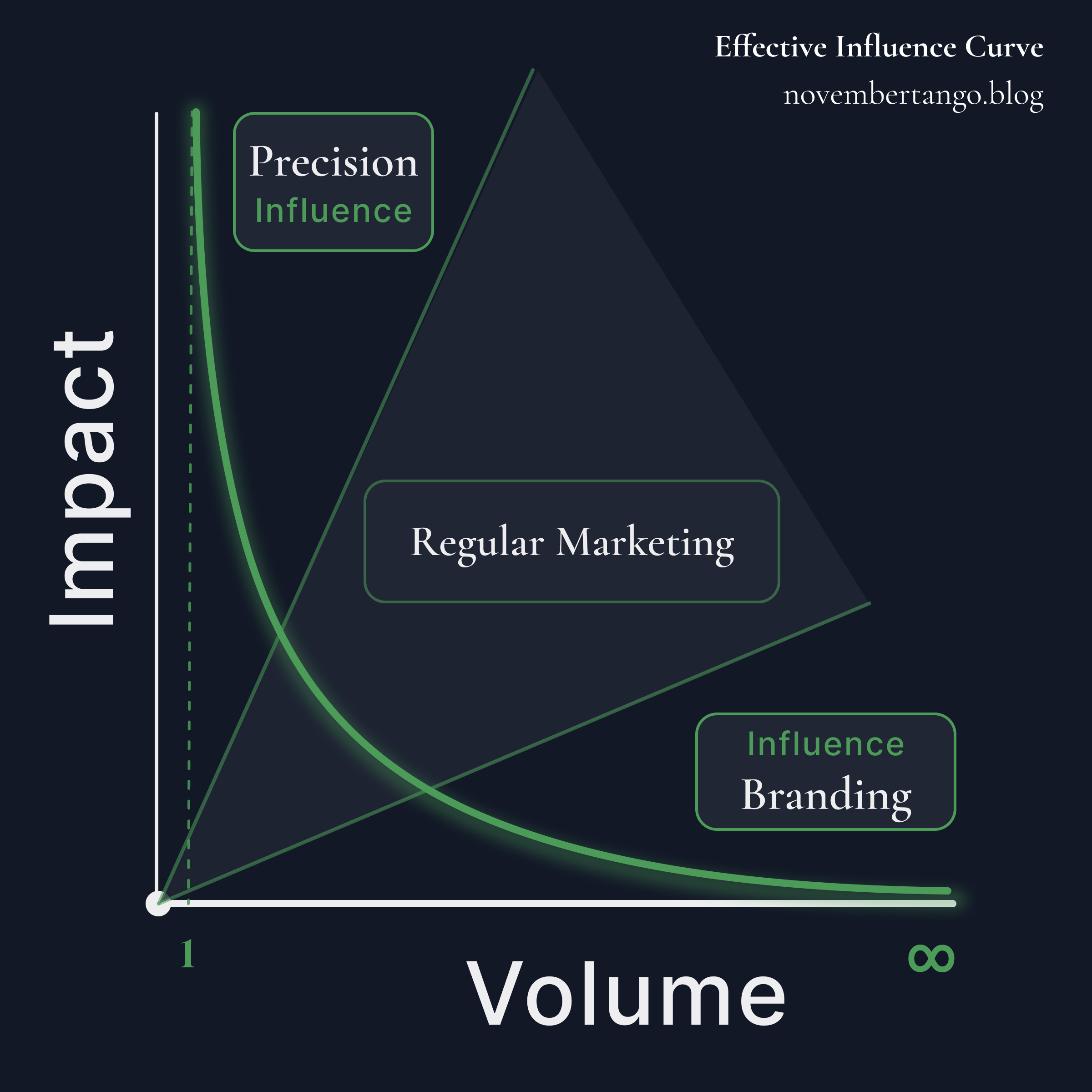
A relevant, timely, and specific message is a strong, precise message. Weaker messages are useful, too. They just need more repetition to brand the idea into your target’s hearts and minds. But remember, repetition won’t save an irrelevant message. Marketing is targeting, after all.
Branding and Precision approaches should be used with various degrees of collaboration. Not this Or that, but this AND that. We don’t do dichotomies here. We leave that for influencing targets. More on that in my next post “How Fox News Manipulates You (and CNN, Too).”
So what determines Impact and how can you engineer it?
Impact comes from Pain and its mirror image Desire, along with Urgency and Specificity.
The more painful (or intensely desirable) a scenario is perceived to be, the more impactful it will be.
The more urgent you can make it seem, the more impactful it will be.
The more specific the case is to your target, the more impactful it will be.
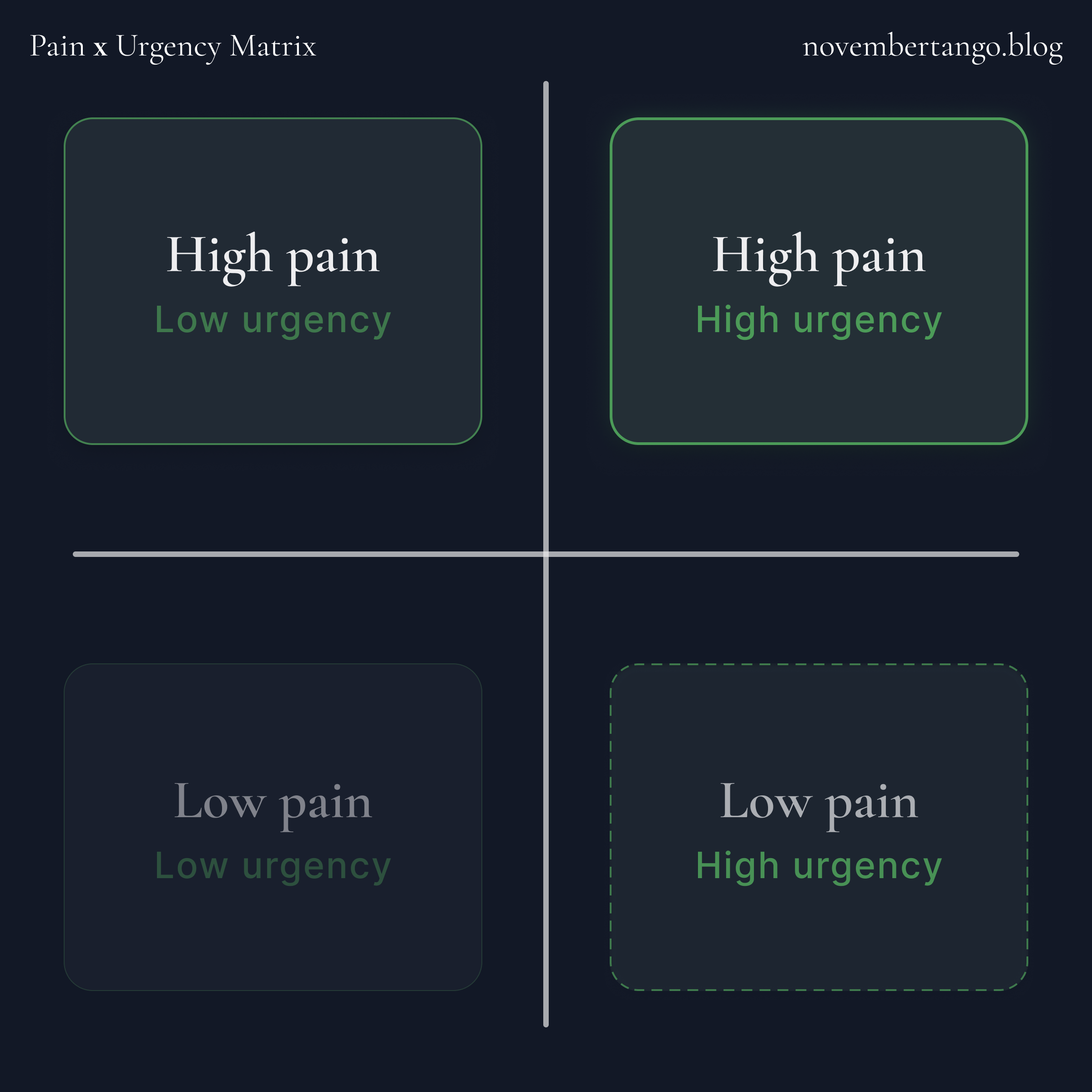
High pain, high urgency will get someone to act now.
High pain, low urgency will get someone to act eventually.
Low pain, high urgency is just a nuisance.
Low pain, low urgency is useless.
Precision influence efforts want to get someone to act now, so it focuses on the high pain, high urgency sector of the quadrant.
Branding is about instilling associations. It’s about creating emotional value about what your offer means to the target. It’s about blurring the line between their identity and your brand’s.
I like how Seth Godin defines branding as “the set of expectations, memories, stories and relationships that, taken together, account for a consumer’s decision to choose one product or service…”
You brand your message in the target’s mind through repetition and omnipresence.
Branding should target the high pain, low urgency quadrant with what we’ll discuss next. It’s the foundation that makes building the house so much easier.
3. Go below the waterline.
Marketing is targeting. It’s a superhuman effort to change someone’s mind. Doable, but rarely worth the effort.
Instead, you’ll target the people who are already susceptible to your message. The people who already want to do what you want them to do, but haven’t yet.
Find them and help them do what they already want to do. If you do it right, they’ll do the hard work for you and invite their friends, who would otherwise ignore you.
But how? You find them by going below the waterline.
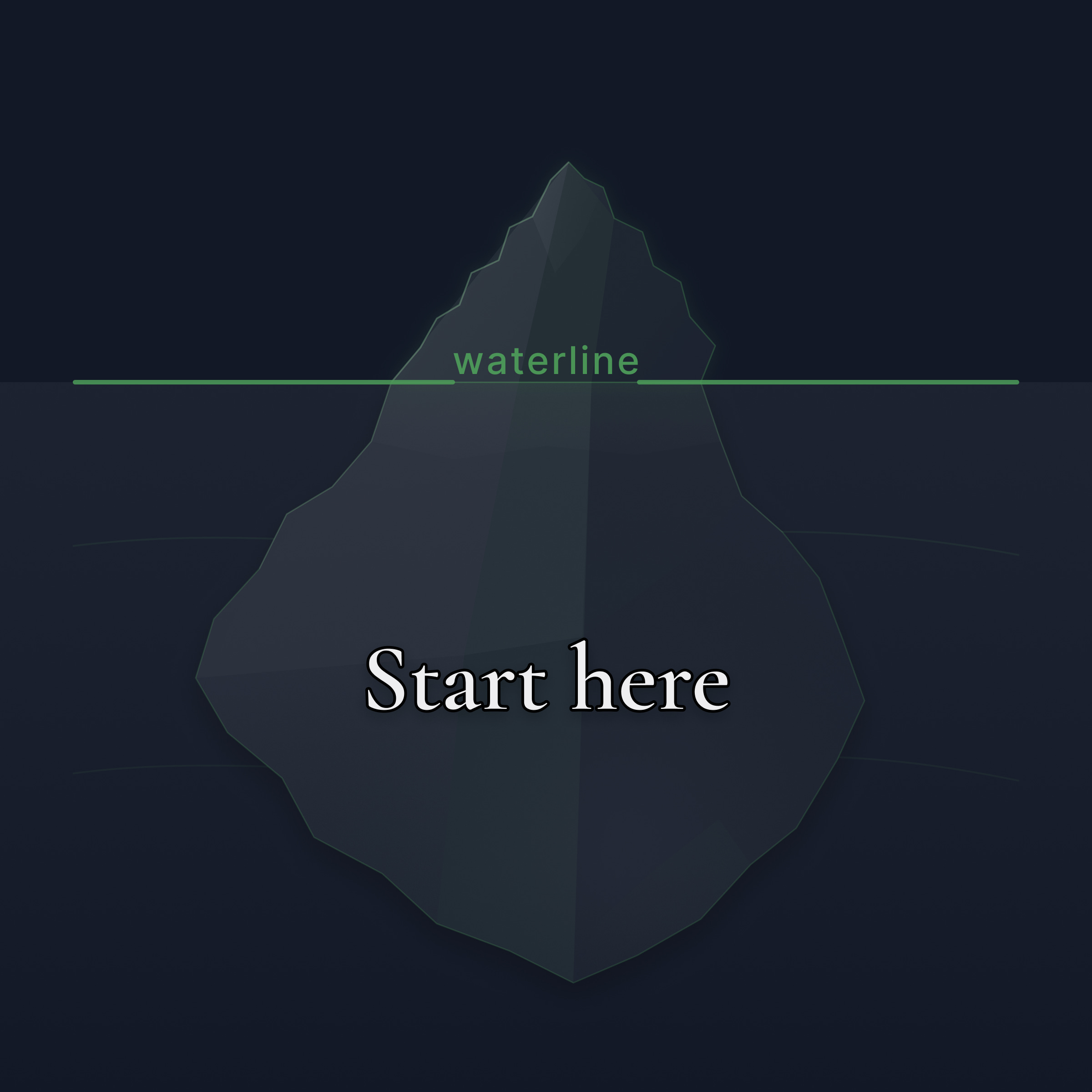
Demographics might help you get a fix on your audience. But rarely do demographics alone predict behavior the way you’d need it.
Everything you need is below waterline: attitudes, motives, beliefs, values, barriers, perceptions, social pressure, access, timing, and their environment.
The Fogg Behavior Model gives us a simple way to work through all that. You get a desired behavior when their motivation and ability are exploited by a timely trigger.
Your job is to target based on motivation and ability. Then craft a message to trigger the response. It’s that simple. But simple ain’t always easy.
Then, there’s Ol’ Reliable: Maslow’s Hierarchy of Needs.
I’ll avoid plagiarizing from my Operator’s Influence Playbook (free when you subscribe). But I will say that the neat thing about the Hierarchy is how it illuminates human vulnerability.
We all have needs. We all want to satisfy those needs.
What are your target’s needs?
How can you be their saving grace?
The answer to those questions can be profound and creative. At the risk of getting overly philosophical here, I encourage you to dig into the depths of human experience.
Let’s go back to the non-profit case.
You got some fresh first time attendees that have shown their motivation by attending your event. But they haven’t they donated yet. Why?
Your team needs to understand what might prevent the donation, the desired behavior.
Motivation: Your attendee might supports the cause in spirit, but can’t see how donating will fulfil their needs. Humans are the most selfish selfless creatures there are. Notice, it’s not about how the donation will support the cause. It’s about how the donation will satisfy their needs.
Ability: Maybe there’s too much friction. The best way to achieve a behavior is to make it easy. The donation form could be too long or complicated. The app or website is glitchy and slow. The commitment seems risky. Without an easy way to opt-out, they’d rather not opt-in.
Trigger: Sometimes you just need to ask. Never put your hands in other people’s pockets. People need a cue. Make the ask.
Once you identify the chokepoint, your team can develop a way to break through it.
If ability is the issue, simplify the form and explain the recurring commitment in plain language. If the trigger is missing, make a specific ask at the end of the event and send a direct link right after while they’re still hot and ready. If they’re lacking motivation, show how this donation will make them a hero.
EXSUM
Ask these five questions before your next campaign:
What specific, measurable, and observable behavior do you want to change?
Who has the power, control, and authority to do it?
What prevents them from doing it now?
How will you layer operations to snap the rubber band resisting your call to action?
How will you measure the effect?
Put this together and you have a strategy, not just random acts of marketing.
Now What?
Thank you for reading!
Psychological Operations are meant to dig deeper. We’ve gone fairly in depth with three integrated steps that help you avoid jumping the gun by hyper-fixating on the transaction.
With what we’ve covered you can escape from the rat race of random acts of marketing and truly dominate your market with influence like you’ve never done before.
I’d love to hear your thoughts. Your feedback means the world to me and it’s the only way I can improve. Comment below or send me an email. I have thick skin, so please, be candid.
Get the influence your work deserves.
I help early stage startups win people over with my influence advisory.
“If you have an apple and I have an apple and we exchange these apples then you and I will still each have one apple. But if you have an idea and I have an idea and we exchange these ideas, then each of us will have two ideas.”
—George Bernard Shaw
* Thank you Ari, Jonatan, and Helen for your feedback. This Article is better now because of you.
Very insightful, thanks!